
Our Services
Treatments chosen for what you actually need
Every Lipo Freeze service exists to answer a specific concern. This page explains each one honestly — how it works, what it can realistically do, who it suits, and just as importantly, who it does not.
A considered range
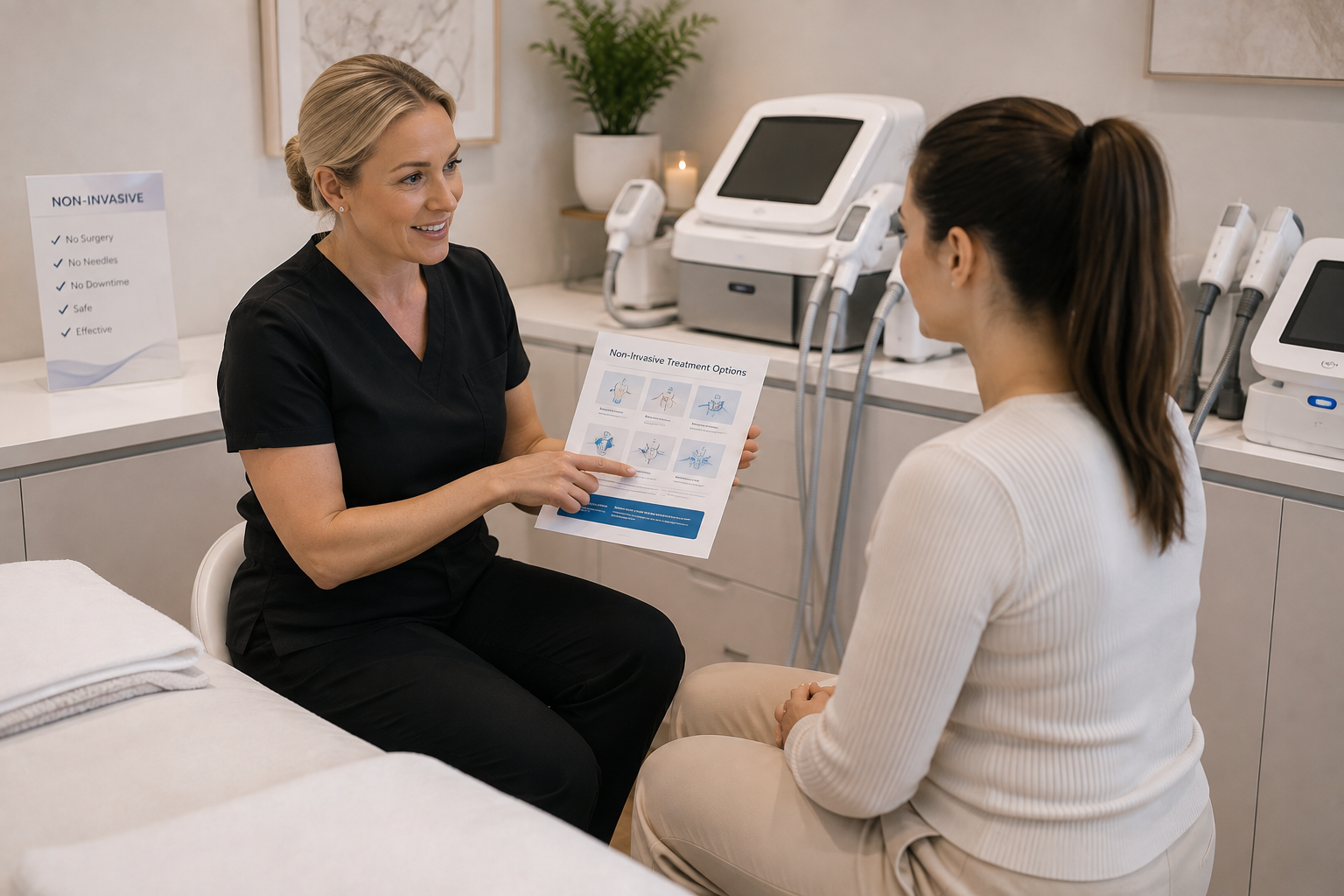
There is a particular kind of frustration that comes from being offered a long list of treatments when what you actually want is an answer to one specific question. Most people do not arrive looking for options. They arrive with something particular in mind — an area that has stopped responding, a change since pregnancy, a loss of confidence that has crept up quietly over a few years — and what they need is someone to tell them plainly whether anything sensible can be done about it.
That is the purpose of this page. Rather than listing services as products to be chosen between, each treatment below is explained in terms of the concern it addresses. You should be able to read through and recognise your own situation, or recognise that it is not here — and both outcomes are genuinely useful.
Lipo Freeze offers four core treatment types. Each is non-invasive. Each is delivered in your own home rather than in a clinic. Each works gradually rather than immediately, and each has clear limits that are stated openly rather than glossed over. None of them are weight-loss treatments, and none of them are substitutes for medical care where medical care is what is actually needed.
What connects them is a shared approach. The technology is only one part of the experience. The rest is the conversation beforehand, the honesty about suitability, the pace at which decisions are made, and the support that continues once the sessions have finished.
The Four Services
- Fat freezing — cryolipolysis for localised, diet-resistant fat
- Body toning — electromagnetic muscle stimulation for tone and definition
- Incontinence support — pelvic floor strengthening, fully clothed
- Vaginal tightening — focused ultrasound for laxity and comfort
All four are non-surgical, require no anaesthetic and no recovery period, and are delivered in the privacy of your own home.
Fat freezing — cryolipolysis for stubborn, localised fat
The treatment most people arrive asking about, and the one with the clearest set of boundaries around what it can and cannot achieve.
What the treatment actually does
Cryolipolysis works on a single, well-documented principle: fat cells are more sensitive to cold than the skin, muscle and nerve tissue surrounding them. That difference in sensitivity creates a narrow but reliable window in which fat cells can be cooled to the point of breaking down while everything around them remains unaffected.
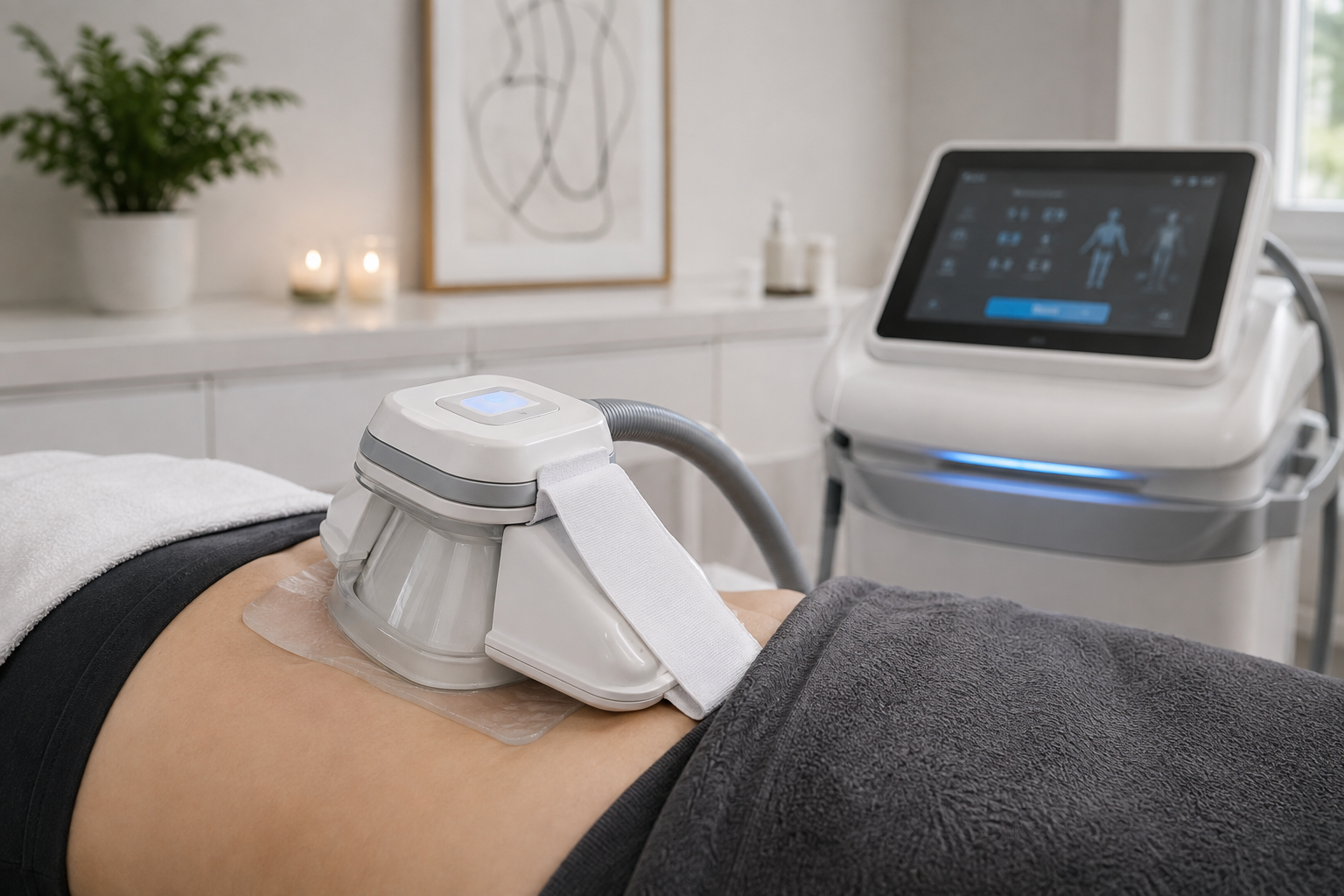
In practice, a protective gel pad is placed over the skin first. A cooling applicator is then positioned over the target area, drawing the tissue gently into the applicator cup so that contact with the cooling panels is even and consistent across the whole area. The cooling cycle runs for a set period, during which the treated fat cells are brought to a temperature that triggers apoptosis — the body's own process of gradual, orderly cell breakdown.
What happens next is the part people tend to underestimate. Nothing is removed during the session. The affected fat cells are cleared slowly by the lymphatic system over the following weeks and months, which is precisely why results appear gradually rather than immediately. The treatment starts a process; your body completes it.
Where it works best
Cryolipolysis targets discrete pockets of fat rather than overall body volume. The areas most commonly treated are the lower abdomen, the upper abdomen, the flanks or love handles, the inner and outer thighs, the upper arms, and the upper and lower back. These are the areas where fat tends to sit in a defined pocket that can be drawn into an applicator — a physical requirement of how the treatment works, not a matter of preference. For people considering an injectable approach to localised fat reduction, Lipo Freeze 2U Aqualyx provides another treatment option to discuss during consultation.
.What it is not
This is the point at which honesty matters most. Fat freezing is not a weight-loss treatment. It will not change what the scales say in any meaningful way, and it is not an appropriate response to a situation where significant weight loss is the actual goal. Anyone who tells you otherwise is either mistaken or selling something.
It is also not a treatment for loose skin. If the concern in a given area is laxity rather than volume, reducing the fat beneath that skin can occasionally make the laxity more apparent rather than less. That is an honest limitation and one that is assessed carefully before anything proceeds.
The realistic timeline
Most people notice the first changes somewhere between three and four weeks after a session. The clearest results typically appear between eight and twelve weeks, and the body may continue clearing treated cells for as long as four to six months afterwards. Many people achieve what they were hoping for from a single session in a given area, though some goals and some areas benefit from a second.
The fat cells cleared in this way do not return. That is a genuine and permanent change. What can change is the behaviour of the remaining fat cells in and around the area, which will still respond to significant weight gain in the ordinary way. Results are lasting, but they are not immune to what happens afterwards.
Who this treatment is not suitable for
Fat freezing is not appropriate for everyone, and suitability is assessed before anything is agreed. It is not recommended for people with cold-related conditions including Raynaud's phenomenon, cold urticaria or cryoglobulinaemia. It is not suitable where there is a hernia at or near the intended treatment site, during pregnancy or while breastfeeding, or where the area in question has very little fat to draw into the applicator or a significant degree of loose skin.
Where someone would be better served by addressing overall weight first, that is said plainly rather than worked around. Being told a treatment is not right for you is not a failed consultation — it is the consultation working correctly.
Body toning — building tone where effort alone has stalled
A different mechanism entirely, addressing a concern that fat reduction on its own cannot resolve.
Why tone is a separate problem
A great many people who think they have a fat problem actually have a tone problem, or a combination of the two. The distinction matters because the two respond to entirely different interventions. Reducing fat in an area with underlying muscle that has weakened will produce a smaller version of the same shape. Building tone beneath that layer changes the shape itself.
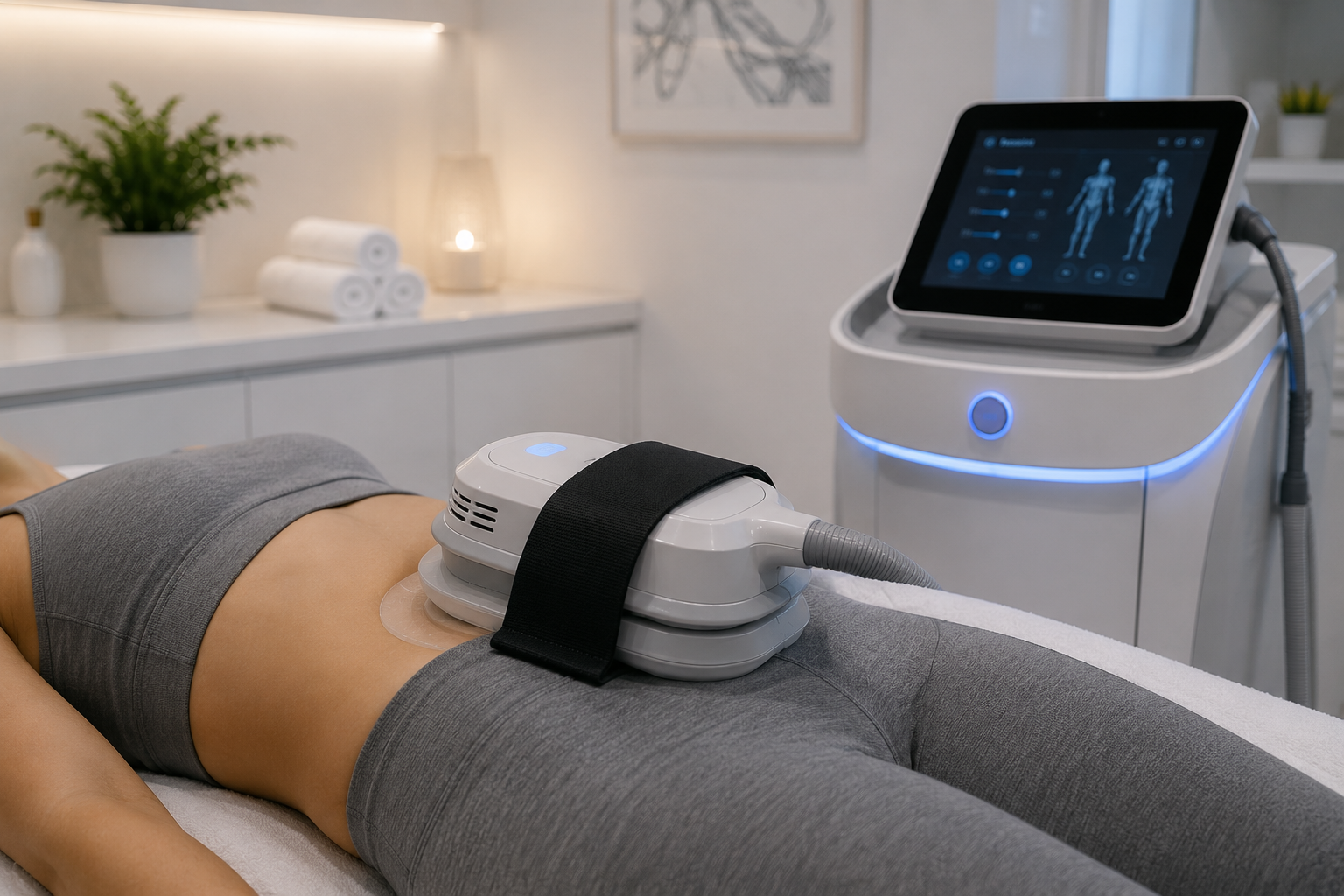
Body toning uses high-intensity focused electromagnetic energy, usually abbreviated to HIFEM. The applicator is positioned over the target muscle group and generates a field that causes the muscle to contract involuntarily and far more completely than voluntary effort allows. During ordinary exercise, most people recruit somewhere between thirty-five and forty per cent of the available muscle fibres in a given movement. These supramaximal contractions engage a substantially greater proportion.
A single thirty-minute session produces in the region of twenty thousand contractions. That density of work is not achievable voluntarily — not because of a lack of willingness, but because the nervous system will not sustain that rate of firing on command.
What the technology is documented to achieve
The figures commonly cited for this class of technology are an increase in muscle mass of up to sixteen per cent in the treated area and a reduction in fat of up to nineteen per cent, developing over a course of sessions. These are upper-range figures from studies of the technology rather than a promise made to any individual, and the honest position is that your own result depends on your starting point, your general health and how consistently the course is completed.
A typical course is four to six sessions. Some people begin noticing a difference from around three weeks, though as with fat freezing the fuller picture takes longer to settle. If body toning and muscle definition are the main concern, you can also explore Lipo Freeze 2U LF2 Sculpt Prices to understand the available treatment and pricing information.
Areas commonly treated
- Abdomen — core strength and definition, including support for abdominal separation after pregnancy
- Buttocks — a lifting effect achieved through muscle development rather than surgery
- Hips and flanks
- Arms — biceps and triceps
- Thighs — front, back and outer
- Calves
Important restrictions
Because this treatment works by generating an electromagnetic field, the contraindications are firmer than for the other services and are not negotiable. It is not suitable for anyone with metal implants, a pacemaker or other cardiac device, or an intrauterine device in place. It is also not appropriate during pregnancy or while breastfeeding, for people with bleeding disorders or epilepsy, or where there is an active hernia or a recent muscle injury in the area to be treated.
This is one of the reasons the initial conversation includes a proper review of your medical history rather than a brief tick-box exercise. Some of these are absolute limits, and it is far better to establish that at the outset than to discover it later.
What "non-invasive" actually means — and what it does not
The phrase is used so widely in aesthetics that it has started to lose its meaning. Here is what it means in the context of these four services.
Non-invasive describes a treatment that does not break the skin. No incision, no needle, no implant, no anaesthetic beyond a topical cream where one is used at all. Everything is delivered through the surface — cold, an electromagnetic field, or focused ultrasound — and nothing is introduced into the body. That is the whole of the definition, and it is worth being precise about because of what people reasonably but incorrectly infer from it.
The first inference is that non-invasive means risk-free. It does not. It means the specific risks associated with surgery are absent: no wound to become infected, no general anaesthetic to react to, no scar, no stitches. Other risks remain and are described plainly during assessment. Fat freezing can produce temporary redness, swelling, bruising, tingling or numbness, and in rare cases a condition called paradoxical adipose hyperplasia, where the treated area increases rather than decreases in volume. Changes in skin pigmentation are uncommon, and frostbite is extremely rare where protocols are followed correctly. None of these are reasons not to proceed for a suitable candidate — they are simply things you are entitled to know before you decide.
The second inference is that non-invasive means the treatment is minor and therefore that assessment is a formality. This is the more consequential misunderstanding. Every service described on this page has genuine contraindications, and several of them are absolute: metal implants and cardiac devices for the electromagnetic treatments, cold-sensitivity conditions for cryolipolysis, pregnancy for all of them. A treatment being non-surgical does not make a proper medical history optional. It makes it the main safeguard, because there is no surgical team and no operating theatre standing behind it.
Why gradual is a feature rather than a compromise
Every treatment here works over weeks rather than in a single afternoon, and this is sometimes presented apologetically, as if it were a shortcoming to be excused. It is not. The gradual pace is inherent to the mechanism in each case, and it brings real advantages.
Fat freezing depends on the body clearing affected cells through the lymphatic system at its own rate. Body toning depends on muscle adapting to load, which is the same biological process that follows any training stimulus and takes the same amount of time. Vaginal tightening depends on new collagen being laid down, which cannot be hurried. In each case the change is produced by your own physiology responding to a trigger, rather than by something being removed or inserted.
The practical consequence is that results appear at a pace that looks like ordinary change. Nobody around you registers a sudden alteration. You are not adjusting to an unfamiliar body overnight. And because the change is produced by your own tissue rather than imposed on it, it tends to sit naturally rather than reading as something that has been done to you.
The equipment that comes to your door
A reasonable question, and one people are often too polite to ask, is whether home-visit treatment means lesser equipment. It does not. The devices used are the same professional-grade systems that would be used in a treatment room; they are transportable, and transporting them is the entire logistical premise of the service. What changes is the location and the absence of a waiting room. What does not change is the equipment, the protocols governing its use, or the standards applied to placement, cycle duration and aftercare.
What home delivery does require is a small amount of practical preparation on your part — a space with a power socket, somewhere comfortable to lie or sit for the duration of the session, and enough privacy that you are not interrupted. That is discussed in advance so that nothing on the day is improvised.
Incontinence support — pelvic floor strengthening, fully clothed
A quiet, widespread and rarely discussed concern, addressed without examination, undressing or embarrassment.
The concern behind the treatment
Bladder control problems are extraordinarily common and almost never talked about. People adjust their lives around them in small, exhausting ways — knowing where every toilet is, avoiding certain kinds of exercise, choosing clothes defensively, declining things they would otherwise enjoy. The adjustments become so routine that many people stop registering them as a problem at all and simply accept a smaller life than they had before.
A great deal of this traces back to the pelvic floor: a sling of muscle supporting the bladder, bowel and, in women, the uterus. Like any muscle group it can weaken — through childbirth, through hormonal change around the menopause, through ageing, through surgery, or through years of heavy lifting or high-impact activity. When it weakens, control becomes less reliable.
The conventional answer is pelvic floor exercises, and they genuinely do work. The difficulty is that they are hard to perform correctly without feedback, hard to sustain over the months required, and easy to abandon quietly when nothing seems to be changing.
How the treatment works
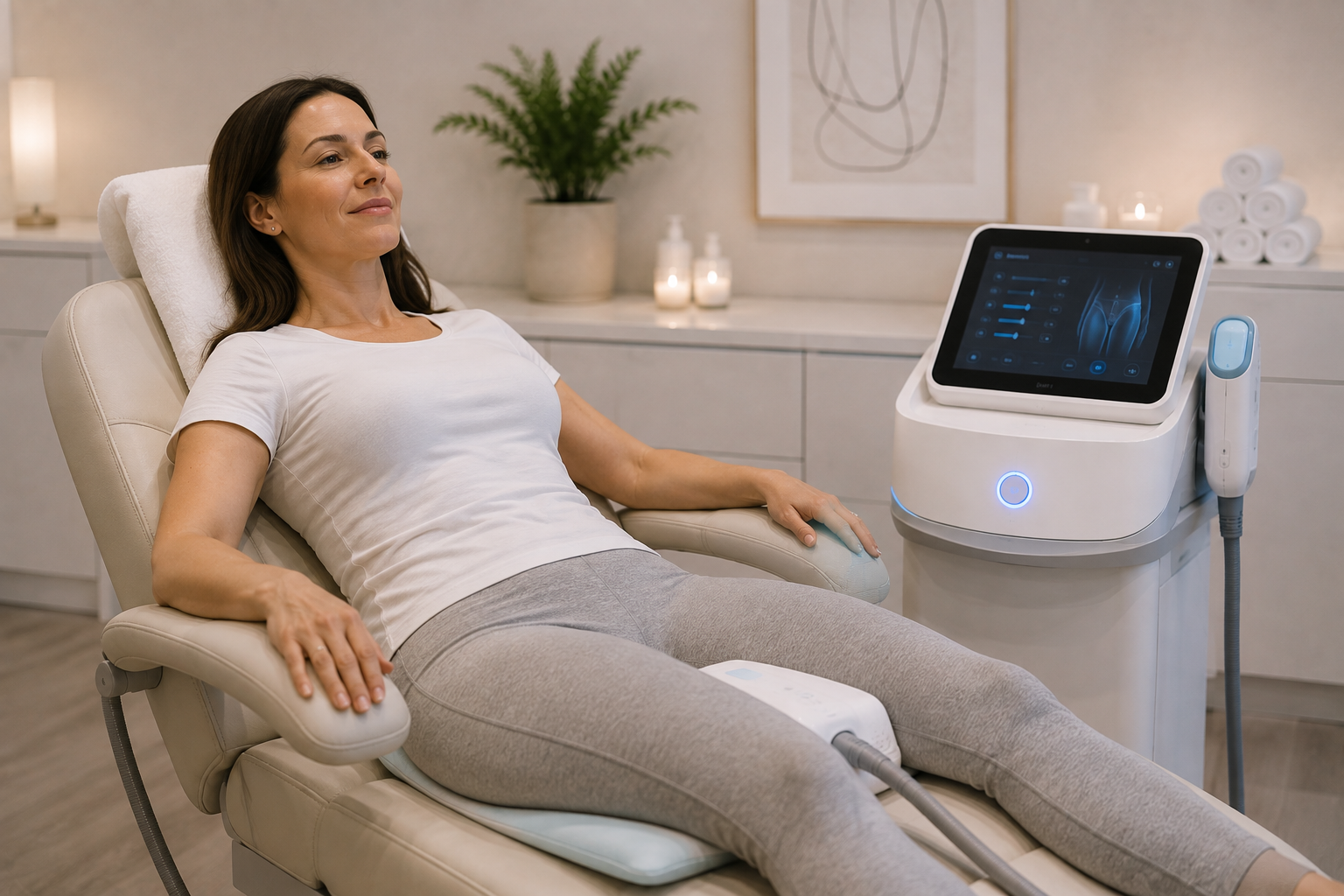
This service applies the same high-intensity focused electromagnetic technology used in body toning, directed at the pelvic floor muscles specifically. You remain fully clothed throughout and seated on a treatment chair — there is no examination, no undressing, no probe and no physical contact of any intimate kind. For a great many people, that alone is the difference between seeking help and continuing to say nothing.
A session lasts around thirty minutes and delivers a volume of contractions equivalent to many thousands of pelvic floor exercises performed correctly and consecutively. The muscles are worked far more thoroughly than voluntary effort allows, and without any need to identify or isolate them yourself.
Course structure and timeline
A full course is generally six to eight sessions, usually taken twice weekly over three to four weeks, though single sessions are available and some people prefer to begin that way. Improvement is often noticed from around three weeks, with the fuller effect continuing to develop as the course completes and the strengthened muscle settles into everyday use.
Concerns this service is used for
Pelvic floor weakness expresses itself in more than one way, and the same underlying cause can produce quite different day-to-day symptoms.
If your situation is not described here, or if symptoms have appeared suddenly or changed rapidly, the right first step is a conversation with your GP rather than a treatment booking. This service supports muscle function; it does not diagnose what is causing a problem.
Stress Incontinence
Leakage that occurs on exertion — coughing, sneezing, laughing, lifting, running or jumping. It happens because the pressure generated in those moments briefly exceeds what the pelvic floor can resist. This is the most common presentation and the one most directly related to muscle strength.
Overactive Bladder and Urge Symptoms
A sudden, difficult-to-defer need to pass urine, often with unusual frequency and often disturbing sleep. The relationship with the pelvic floor is less direct than with stress incontinence, but improved muscular control frequently helps people defer urgency for long enough to reach a toilet comfortably.
Postnatal Recovery
Pregnancy and delivery place sustained demand on the pelvic floor, and recovery is not automatic. Many women are told to do their exercises and left to it. Structured strengthening gives that recovery a defined shape and a clear endpoint rather than an open-ended instruction.
Menopausal Change
Falling oestrogen affects the tone and resilience of pelvic tissue, and bladder control commonly becomes less reliable during and after the menopause. Strengthening the supporting muscle addresses one part of that picture, though it does not alter the hormonal change underlying it.
Faecal Incontinence
Less frequently discussed than bladder symptoms and often more distressing. The same muscle group is involved in bowel control, and strengthening it can improve confidence and reliability. Where this symptom is new or worsening, medical assessment should come first.
Erectile Function in Men
The pelvic floor plays a role in erectile function that is not widely understood. Men make up a meaningful proportion of the people who use this service, both for bladder control — particularly after prostate surgery — and for this reason. The treatment is identical: seated, clothed, thirty minutes.
Vaginal tightening — a non-surgical response to laxity and discomfort
The service that requires the most careful conversation, and the one where honest assessment matters most.
How the treatment works
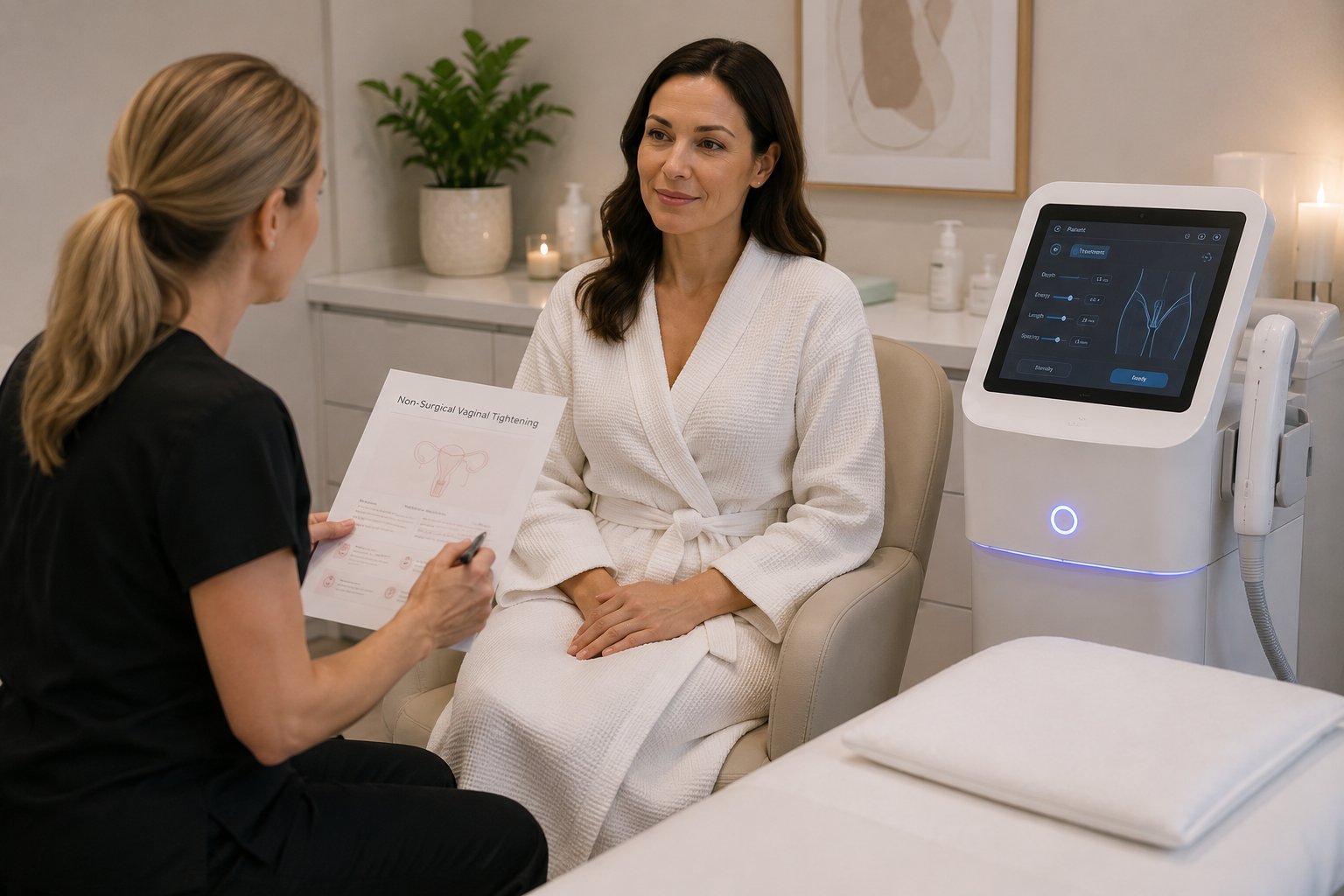
This treatment uses high-intensity focused ultrasound, delivered internally through a specialised applicator. Focused ultrasound passes through the surface tissue and deposits energy at a controlled depth, warming the deeper layer to a temperature that prompts the body to produce new collagen and elastin. Those two proteins largely determine how firm and elastic tissue feels, and both decline with age, hormonal change and the demands of childbirth.
Nothing is cut, removed or injected. The result develops as the body rebuilds, which is why it appears over weeks rather than immediately — the same gradual pattern that characterises every service described on this page.
What a session involves
A consultation comes first, covering medical history, previous births, any surgical history and what you are actually hoping the treatment will change. A topical numbing cream is applied and given time to work. The treatment itself takes around thirty minutes. Afterwards there may be mild soreness or slight swelling for a few days, and specific aftercare guidance is provided.
Most people benefit from a course of three sessions spaced four to six weeks apart, allowing collagen to develop between appointments. Results commonly last from several months to somewhat over a year, varying with age, hormonal status and individual tissue response.
What people seek it for
- Reduced tone or elasticity, most often following childbirth
- Mild stress incontinence occurring alongside laxity
- Dryness and reduced natural lubrication related to hormonal change
- Discomfort or reduced sensation during intercourse
- Age-related collagen loss affecting comfort and confidence
For those specifically researching non-surgical options for intimate wellness and tissue rejuvenation, Lipo Freeze 2U Vaginal Rejuvenation provides further information about the treatment and its pricing.
A necessary note on caution
Energy-based devices used for vaginal treatments have attracted legitimate scrutiny, and regulators have warned that they can carry serious risks when used inappropriately or without proper assessment. That warning is repeated here rather than omitted, because you are entitled to weigh it.
What it means in practice is that the assessment beforehand carries more weight than for any other service offered. If your symptoms suggest something that should be examined by a doctor — pain, bleeding, prolapse, infection or any recent change — the correct answer is a medical appointment, and that is what you will be told. Where the concern is genuinely one of tone, comfort and confidence, and where you have understood both what the treatment can offer and what has been said about the risks, it is a reasonable option to consider.
What happens, in order, whichever service you choose
The sequence below is the same for every treatment. Only the content of the assessment and the session itself differs.
A conversation before anything else
The first contact is a conversation, not a booking. You describe what has prompted you to look into this, and you ask whatever you want to ask. Nothing is scheduled at this stage and no decision is expected. If it becomes clear during that conversation that no service offered here is the right answer, that is said directly and the conversation ends there without awkwardness.
Assessment and suitability
This covers relevant medical history, current medication, previous procedures, and a proper look at the specific area or concern. Every service on this page has genuine contraindications, several of them absolute, and this is where they are established. It is also where expectations are set — what a realistic outcome looks like for you specifically, how many sessions that is likely to involve, and how long it will take to appear.
Your session, at home
Equipment is brought to you. There is no travel, no waiting room and nobody else present. You can be in your own clothes, in your own space, with your own tea. Sessions run between thirty minutes and around an hour depending on the treatment and the number of areas involved, and you are told beforehand what to expect the sensation to feel like so that nothing during the session comes as a surprise.
The weeks that follow
Every service here works gradually. You return to normal activity immediately — there is no recovery period for any of them — and the change develops quietly over the following weeks. Aftercare guidance is specific to the treatment received rather than generic, and there is a clear description of what to look for and when, so that you are not left guessing whether something is working.
Review, and an honest verdict
Once enough time has passed for a fair judgement, the outcome is reviewed properly. Sometimes the answer is that a further session would add something worthwhile. Sometimes it is that you have reached what the treatment can sensibly offer and a second round would be spending money for very little return. Both answers are given plainly, because the second one is the reason the first can be trusted.
Which service answers which concern
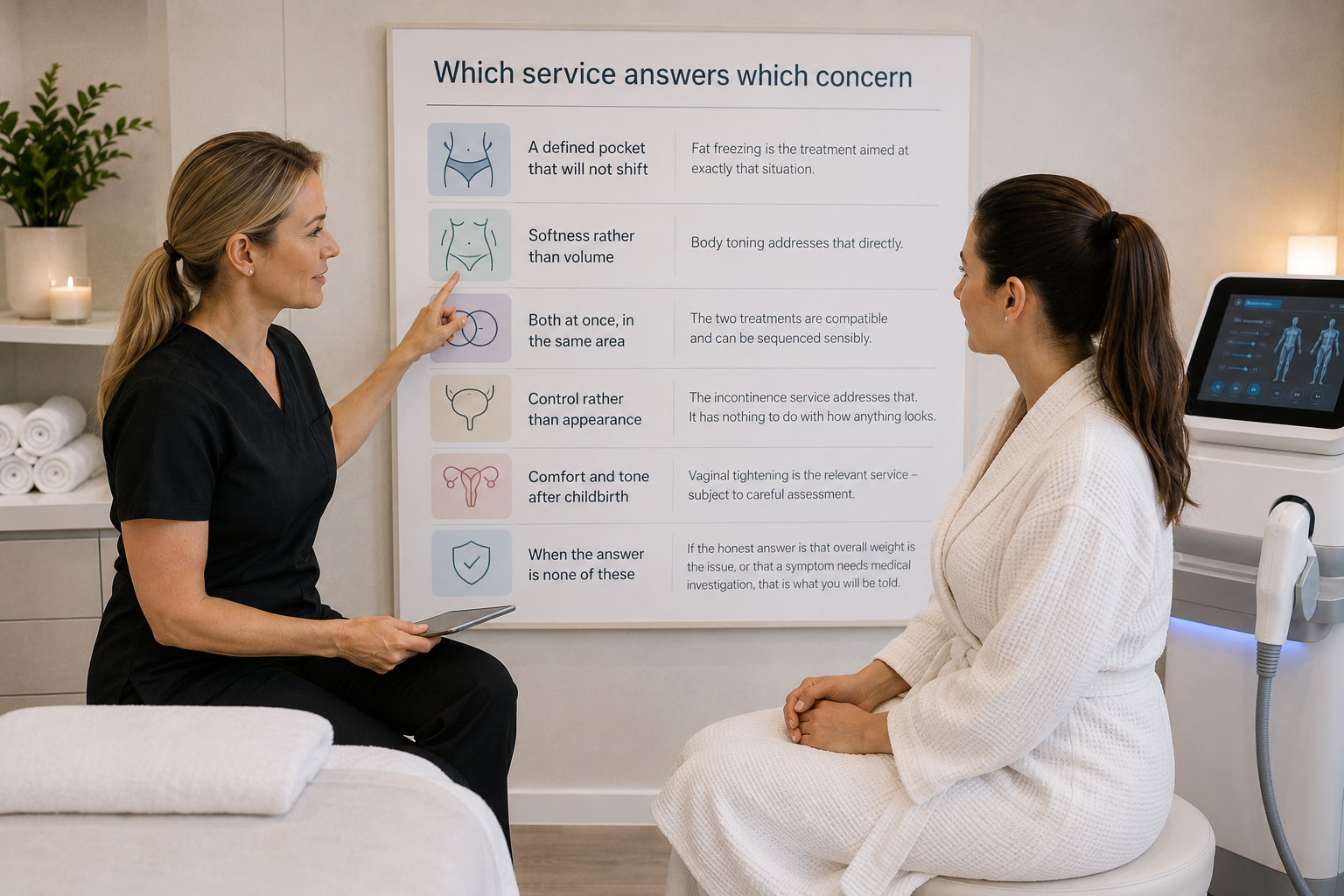
Most people are unsure which treatment applies to them, and that uncertainty is entirely reasonable — the distinctions are not obvious from the outside.
A defined pocket that will not shift
If you are broadly at a stable weight and there is one specific area that has not responded to sustained effort, fat freezing is the treatment aimed at exactly that situation. It is the wrong answer for general weight reduction.
Softness rather than volume
If the area is not especially large but lacks firmness or shape, the underlying issue is more likely muscle tone than fat. Body toning addresses that directly, and it is a genuinely different mechanism rather than a variation on the same one.
Both at once, in the same area
The two frequently occur together, particularly across the abdomen after pregnancy or a period of weight change. The two treatments are compatible and can be sequenced sensibly, which is discussed properly rather than assumed as an upsell.
Control rather than appearance
If what has changed is bladder reliability, confidence during exercise, or the size of the life you feel able to live around it, the incontinence service addresses that. It has nothing to do with how anything looks.
Comfort and tone after childbirth
Where laxity, dryness or discomfort is the concern, vaginal tightening is the relevant service — subject to the more careful assessment described above, and subject to ruling out anything that requires a doctor first.
When the answer is none of these
If the honest answer is that overall weight is the issue, or that a symptom needs medical investigation, that is what you will be told. Sending someone away is not a lost sale — it is the only version of this service that is worth trusting.
Questions about the services
Answered directly, including the ones with inconvenient answers.
Yes, and for some concerns a combination genuinely works better than either treatment alone — fat freezing and body toning across the abdomen being the most common example. Combinations are sequenced rather than stacked arbitrarily, with sensible spacing between them, and they are only suggested where there is a real reason. If one treatment will achieve what you are after, you will be told that instead.
None are described as painful, though each has a distinct sensation worth knowing about in advance. Fat freezing involves intense cold and a pulling sensation for the first several minutes, which eases as the area numbs. Body toning and the incontinence treatment produce a strong involuntary contraction that feels unusual at first but is not painful, and the intensity is adjusted to what you find comfortable. Vaginal tightening is performed after topical numbing and is generally described as warm rather than sore.
No. None of these treatments requires a recovery period. You can drive, work and exercise the same day. Some temporary tenderness, numbness or slight swelling in the treated area is normal and settles on its own. Vaginal tightening may leave mild soreness for a few days, which is the most noticeable after-effect across the four services.
Because for these particular concerns, privacy is not a luxury but the thing that determines whether people seek help at all. Someone weighing up whether to discuss bladder leakage is far more likely to do so in their own front room than in a shared waiting area. The practical benefits — no travel, no waiting, appointments that fit around your day — matter too, but the privacy is the main reason.
It depends on the treatment and on you. Fat freezing often achieves a good result from a single session per area. Body toning is normally a course of four to six. The incontinence service is typically six to eight over three to four weeks. Vaginal tightening is usually three sessions spaced four to six weeks apart. These are starting points discussed and adjusted during assessment, not fixed packages you are required to commit to in advance.
Individual response varies, and no honest service can guarantee an outcome. What can be controlled is the quality of the assessment beforehand, which is precisely where the risk of disappointment is reduced — most poor outcomes trace back to someone being treated who should not have been, or expecting something the treatment was never capable of delivering. If a result falls short of what was described, that is discussed openly rather than explained away.
Four treatments, and the honesty to say when none of them apply
Each of these services does one thing reasonably well and a great many things not at all. Fat freezing reduces defined pockets of fat and does nothing for overall weight. Body toning builds muscle and does not tighten skin. The incontinence service strengthens the pelvic floor and does not diagnose why it weakened. Vaginal tightening prompts collagen renewal and is not a treatment for anything that needs a doctor.
Stating those limits plainly is not modesty. It is the only way the positive claims carry any weight at all. A service that promises everything is really promising nothing you can rely on.
If something here describes your situation, the sensible next step is a conversation in which you ask the awkward questions and get straight answers. If nothing here describes it, that conversation is still worth having being pointed somewhere more appropriate is a genuinely useful outcome.